NUMSA International Health & Leadership Summit 2024
A two-day immersive experience focused on innovation, leadership, and sustainable solutions in healthcare, exploring the intersection of medicine and technology.
NUMSA International Health & Leadership Summit 2024 (IHLS’24)
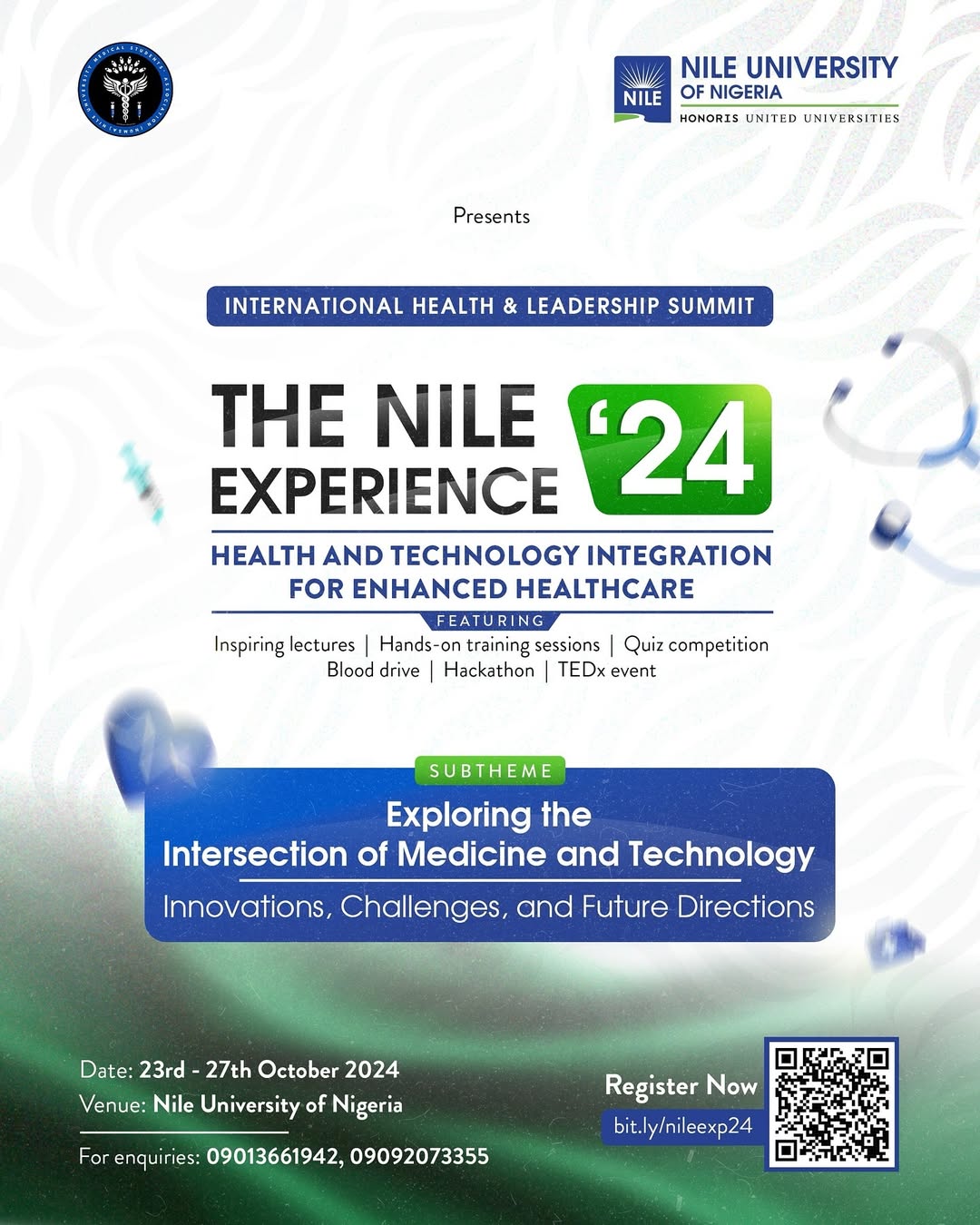
THE NILE EXPERIENCE ‘24
The NUMSA International Health and Leadership Summit 2024 (IHLS’24) convened healthcare professionals, thought leaders, and students for a two-day immersive experience focused on innovation, leadership, and sustainable solutions in healthcare. Through expert-led lectures, interactive discussions, and collaborative activities, participants explored pressing healthcare challenges and transformative strategies relevant to Nigeria and the global health ecosystem.
Event Details
Date
23rd - 27th October 2024
Venue
Nile University of Nigeria
Theme
Health and Technology Integration for Enhanced Healthcare
Subtheme
Exploring the Intersection of Medicine and Technology: Innovations, Challenges, and Future Directions
Summit Activities
The summit featured a comprehensive program including:
- Inspiring Lectures - Expert-led sessions on cutting-edge healthcare topics
- Hands-on Training Sessions - Practical workshops and skill-building activities
- Quiz Competition - Knowledge-based challenges for medical students
- Blood Drive - Community health initiative
- Hackathon - Innovation competition for healthcare solutions
- TEDx Event - Thought-provoking talks on healthcare leadership
- Pitch-In Competition - Innovation pitch competition for healthcare solutions
- Medical Nexus Launch - Comprehensive compendium on common diseases in Nigeria
- KABED Award - Recognition ceremony for outstanding contributions
Day 1: Innovation, Responsibility, and Emotional Intelligence in Healthcare
Health and Technology Integration for Enhanced Healthcare in Nigeria
Technology integration is reshaping healthcare delivery in Nigeria by improving patient outcomes, increasing access to care, and streamlining clinical processes. Digital health tools are increasingly becoming indispensable in modern medical practice.
Challenges in Nigeria’s Healthcare System
- Limited Access: Rural and remote communities often lack adequate healthcare infrastructure and trained professionals
- Rising Costs: Escalating healthcare expenses continue to burden families and the health system
- Shortage of Professionals: The “Japa syndrome” has contributed to brain drain, leaving critical workforce gaps
- Outdated Systems: Traditional healthcare practices and inefficient systems hinder effective service delivery
Benefits of Technology Integration
- Improved Patient Outcomes: Real-time data and advanced diagnostics enable timely and accurate treatment
- Reduced Errors: Artificial Intelligence (AI) and Electronic Health Records (EHRs) improve diagnostic and procedural accuracy
- Faster Turnaround Times: Digital tools streamline workflows, saving time and resources
Applications of Digital Health
- Health Information Systems (HIS)
- Telemedicine for remote and underserved populations
- Internet of Medical Things (IoMT) for real-time patient monitoring
- Electronic Health Records (EHR)
- Artificial Intelligence (AI)
- Mobile Health (mHealth)
Case Study: Tuberculosis in Nigeria
Nigeria bears the highest tuberculosis (TB) burden in Africa. Subclinical TB often goes undiagnosed due to asymptomatic presentation. Digital X-ray technology with Computer-Aided Detection (CAD) allows early diagnosis and timely intervention. Tools such as XMAP facilitate remote interpretation of radiographs, extending specialist expertise to underserved areas.
Key Takeaway: Investment in healthcare technology is no longer optional. Policymakers must prioritize cybersecurity, workforce training, and equitable access to digital health resources.
Drug Abuse and the Role of Medical Professionals
Speaker: Mr. Owonubi Gbenga
Drug abuse remains a growing public health concern in Nigeria, affecting individuals, families, and communities. The session examined patterns of substance abuse, underlying drivers, and the critical role of healthcare professionals in prevention and treatment.
Forms of Drug Abuse
- Recreational drug use (e.g., cannabis)
- Misuse of opioids such as tramadol and codeine
- Polydrug use (simultaneous use of multiple substances)
Drivers of Drug Abuse
- Peer pressure
- Increased drug availability
- Socioeconomic factors including unemployment and poor parenting
Signs of Drug Abuse
- Behavioral changes: Truancy, poor hygiene, and indifference
- Physical symptoms: Blackened lips, runny nose, and bloodshot eyes
Role of Medical Professionals
- Early detection and screening
- Public education on risks and prevention
- Collaboration with agencies such as the NDLEA for broader impact
Key Takeaway: Combating drug abuse requires a coordinated, multi-sectoral approach, with healthcare professionals playing a frontline role in prevention and early intervention.
Emotional Intelligence for Healthcare Professionals
Speaker: Ike Okoye
Emotional intelligence (EI) is essential for effective patient care and professional resilience. The session highlighted how emotional awareness and regulation enhance communication, empathy, and stress management in healthcare settings.
Four Pillars of Emotional Intelligence
- Self-Awareness: Recognizing personal emotions and triggers
- Self-Management: Regulating emotional responses through techniques such as deep breathing
- Social Awareness: Understanding and empathizing with patients and colleagues
- Relationship Management: Building meaningful and productive professional relationships
Key Takeaway: Emotional intelligence is a critical clinical skill that improves patient relationships, reduces burnout, and enhances overall healthcare outcomes.
Day 2: Experience, Mental Health, and Stewardship
Personal Experience in Health and Technology Integration
Speaker: Dr. Amos Omoniyi
Dr. Omoniyi shared practical insights on how technological advancements are transforming healthcare delivery. From TB diagnostics to multi-disease platforms, tools such as GeneXpert and TB-LAMP enable faster, more accurate bedside testing for TB, COVID-19, and hepatitis.
Key Takeaway: Scalable and adaptable technologies are essential for effective diagnosis and treatment, particularly in resource-limited settings.
Mental Health for Healthcare Professionals
Mental health is foundational to quality healthcare delivery, yet it is often neglected among healthcare workers.
Common Mental Health Challenges
- Burnout: Chronic workplace stress leading to physical and emotional exhaustion
- Compassion Fatigue: Emotional depletion from prolonged caregiving
- Post-Traumatic Stress Disorder (PTSD): Trauma arising from high-stress clinical environments
Warning Signs
- Chronic fatigue
- Social withdrawal
- Reduced performance
- Irritability
Self-Care Strategies
- Prioritizing rest and relaxation
- Practicing mindfulness and stress-reduction techniques
- Seeking professional or peer support when overwhelmed
Key Takeaway: Addressing mental health is not a luxury—it is a necessity for sustaining compassionate and effective healthcare delivery.
Antimicrobial Stewardship
Speaker: Dr. Philip Nwajobi-Princewill
Antibiotic misuse is a major driver of antimicrobial resistance, posing a global health threat. Antimicrobial stewardship emphasizes the responsible use of antibiotics through adherence to the Six “R’s”:
- Right patient
- Right drug
- Right dose
- Right route
- Right duration
- Right outcome
Key Takeaway: Stewardship programs are essential to reduce resistance, improve patient outcomes, and preserve the efficacy of life-saving medications.
Pitch-In Competition and Knowledge Expansion
Pitch-In Competition
The Pitch-In Competition inspired medical students to critically examine Nigeria’s healthcare challenges and propose innovative, long-term solutions. Participants were encouraged to translate ideas into actionable interventions that address real-world healthcare problems.
Medical Nexus Launch
The summit also featured the launch of Medical Nexus, a comprehensive compendium addressing common diseases in Nigeria. The publication explores:
- Infectious and chronic conditions
- Maternal and child health issues
- Global health implications
This resource equips medical students with context-specific and globally relevant knowledge, bridging the gap between local healthcare challenges and international best practices.
Media & Resources
📱 Follow the Summit
Conclusion
The NUMSA International Health and Leadership Summit 2024 reinforced the importance of innovation, emotional intelligence, mental health, and responsible clinical practice in building sustainable healthcare systems. Participants left the summit empowered with actionable insights and renewed commitment to driving positive change within their communities and beyond.
The summit successfully:
- Bridged knowledge gaps between technology and healthcare delivery
- Fostered leadership skills through emotional intelligence training
- Addressed critical public health issues including drug abuse and antimicrobial resistance
- Promoted mental health awareness among healthcare professionals
- Inspired innovation through competitions and knowledge sharing
- Launched valuable resources like Medical Nexus for ongoing learning
This event exemplifies NUMSA’s commitment to advancing healthcare education, fostering leadership, and preparing the next generation of medical professionals to tackle complex health challenges in Nigeria and globally.
Credits
Event: NUMSA International Health & Leadership Summit 2024 (IHLS’24)
Theme: “THE NILE EXPERIENCE ‘24”
Date: October 23-27, 2024
Venue: Nile University of Nigeria
Organizer: Nile University Medical Students’ Association (NUMSA)
Registration: bit.ly/nileexp24
For Enquiries: 09013661942, 09092073355